Understanding Uglish
Ugandan blogger, Uwera Marthaa, offers an interesting analysis of Ugandan English used in literature along with some common terms.

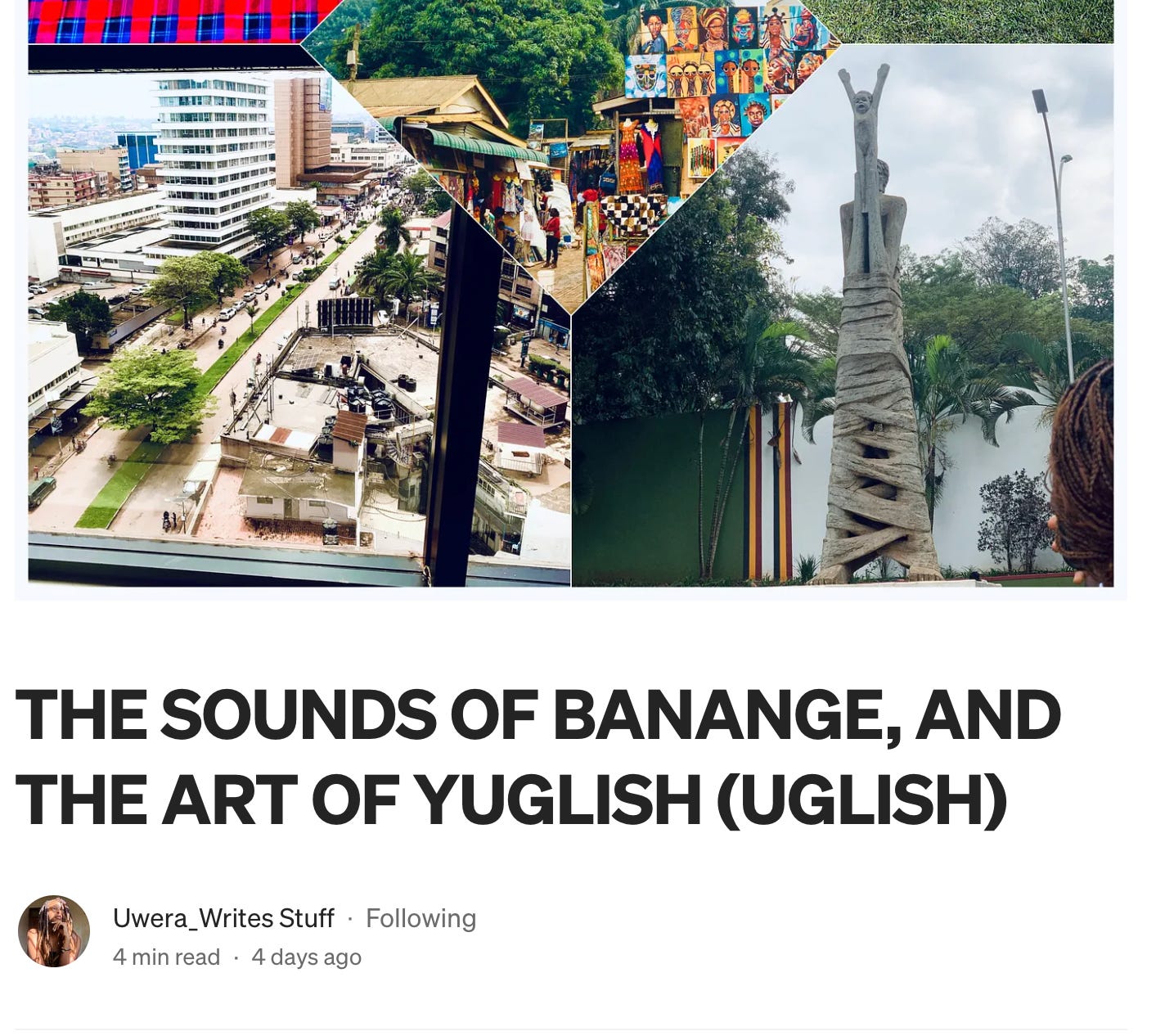
Medium blogger, Uwera Marthaa writes an amazing article The Sounds of Banange, and the Art of Yuglish (Uglish) where she shares her thoughts on reading and hearing my poem The Sounds of Banange that I read at FEMRITE’s ‘Author of the Month’ event last Monday. She also highlights the way in which Uglish is used by Ugandan authors, and in my case an author connected to the country by virtue of my wife and child. The last part of the article shares a few useful Uglish phrases that I highly enjoyed.
In The Sounds of Banange, I celebrate how Ugandans use the Luganda word Banange in their everyday lives. Through the rhetorical device of anaphora, I repeat the word then contextualize it with an everyday gone wrong scenario to drive home the meaning – an effect that native Luganda speakers recognize and that non-native speakers end up inferring. The variety in stanza form from right to left is also meant to keep the reader moving their eyes to the musicality of the word.
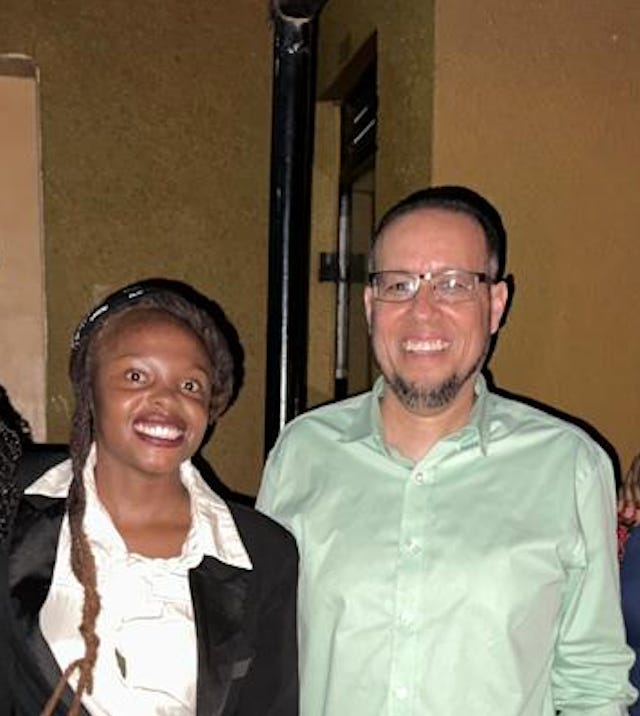
As more of my poems are published and quite hopefully in the near future my chapbook and MFA thesis anthology, it feels humbling to see what Barthes calls The Death of the Author happening with my work. While this post is meant to promote Uwera’s article, I want to mention a few things about Uglish.
The word Uglish is a portmanteau of the words Uganda and English or Ugandan + English. While Uganda is a country and not a language, the Ug- combined in Uglish represents the diversity of the Pearl’s many languages. The ways in which Ugandans express themselves via the mix of their native language with English provides a sophisticated mode of expression that belongs to a larger body of English use known as World Englishes.
Many Ugandans I’ve spoken with feel that the English they communicate with is somehow inferior to the spoken English of America, Canada, Australia or England. I often remind them that when it comes to informal speech, there is no right or wrong way to express themselves as long as they are understood.
I give an example of this sophistication in my Substack post, My Wife’s Ugandan English Is Divine. Although I refer to Uglish as Ugandish, after reading Uwera’s post I prefer the former as it truly encompasses the representation of Ugandan English.
Uglish is a type of linguistic code-meshing (other scholars prefer the nominalizations code-switching or code-mixing) where two languages – or in some cases two dialects – come together as one form of expression. Code-meshing also includes incorporating ideas, concepts, idioms, metaphors and other forms of expression from one language into the other or vice versa. Sometimes, code-meshing occurs unintentionally from a mistake in pronunciation or from a misunderstanding of the second language and a word emerges. Such occurrences are colloquially labeled as instances of ‘broken English’ but in my field of applied linguistics, these linguistic phenomena are recognized as sophisticated productions of what we call interlanguage.
An example that I can think of in poetry where a native Ugandan language is mixed with English is in Ber Anena’s A Nation of Labour in her poem We Arise where she says,
“We learn, / from decades of fleeing our homes, / dodging pricks from okutu lango / avoiding tumbles on dul yen / tearing through thickets of agaba / freeing from marshy kulu. (47)”
Anena uses a wegotism to invoke the struggle of her fellow northerners and reinforces that unity by employing Acholi words instead of English ones. There’s currently a controversy surrounding the use of italics for foreign words that isn’t getting much traction in academic writing, but Anena’s use of it I feel is meant to stress ‘we’ have our language and it isn’t Luganda. This genius technique compels the non-Acholi speaker to consult Google, a native Acholi speaker, or infer the meanings of these italicized words from the surrounding text.
Another example occurs in Ronald Ssekajja’s Footsteps of the Kakalabanda in the lines of his poem My Neighbour’s Wife,
“She lingers around doing nothing / but miming Winnie Nwagi’s songs. / She particularly likes “Njagala kuwa kumbeera”: / literally meaning / “I want to give you a better feeling,” the devil she is! (7)”
Ssekajja employs an appositive to help the reader understand the title of the song in Luganda. The code-switching here is intentionally a cultural reference meant for non-Luganda speakers; if it wasn’t, the poet would’ve left the appositive out as the title in its native form infers shared knowledge.
A few interesting examples of code-switching in interlanguage is found in the anthology A Child Is A Seedling where several poets use ‘am’ instead of the full form ‘I am’.
In the poem, A Child is a Seedling, Wandawa Samantha asks,
“Why is it ‘am to suffer / In the journey of life so long?”
And Akwero Frankline Vivian proclaims in Back Again,
“Am scared of nightfall / The night wind whistles hymns of sadness,”
While Abdinur Mariam, in two separate poems, uses it first in The Emptiness of My Body,
“Perhaps am just an emotional freak? / Perplexed, I am what haunts me.”
And then again in Repairing Broken Eggs,
“They think am the urn / That holds the ashes of their wrath / They think am a board / They can write on and never erase.”
Some may argue that the usage here is purely a clipped word or perhaps ellipsis of some sort, however given their function throughout the verses, it’s clear that the poets are expressing an existential existence pertinent to the overall context of each line.
Such is the uniqueness of Uglish that I wish I could further expand on. Suffice it to say that we are seeing the rise of Uglish and its recognition in literature in much the same way that Nigerian English made the scene years ago. Uwera’s article is the start of something bigger that I think we are going to see more Ugandan bloggers, readers, and critics commenting about.
Follow Uwera on X at @UweraMarthaa, and on Medium at Uwera_Writes Stuff.